ai-practice · 2026-07-29
Struggling to Publish Consistently? I Built a Content System with Codex
By Tymon Tang
Publishing consistently is less about discipline than about building a system. Here is how I used Codex to connect idea capture, topic selection, writing, editing, and feedback—and what two weeks of hands-on iteration taught me.
If you create content, you have probably struggled with publishing in fits and starts.
I used to think consistency was mostly a matter of discipline. I would labor over ideas, yet still publish only once every week or two. The frustration eventually triggered my product-builder instincts: if I wanted to keep creating, I needed a system that could continuously generate topics, support production, and provide enough feedback to keep me going.
For the past two weeks, I have been building that system with Codex.
Here are three things it can already do for me: edit talking-head videos, research creators such as ZaraZhang and Li Shouzhou, and turn my experience and current work into a structured topic pyramid.
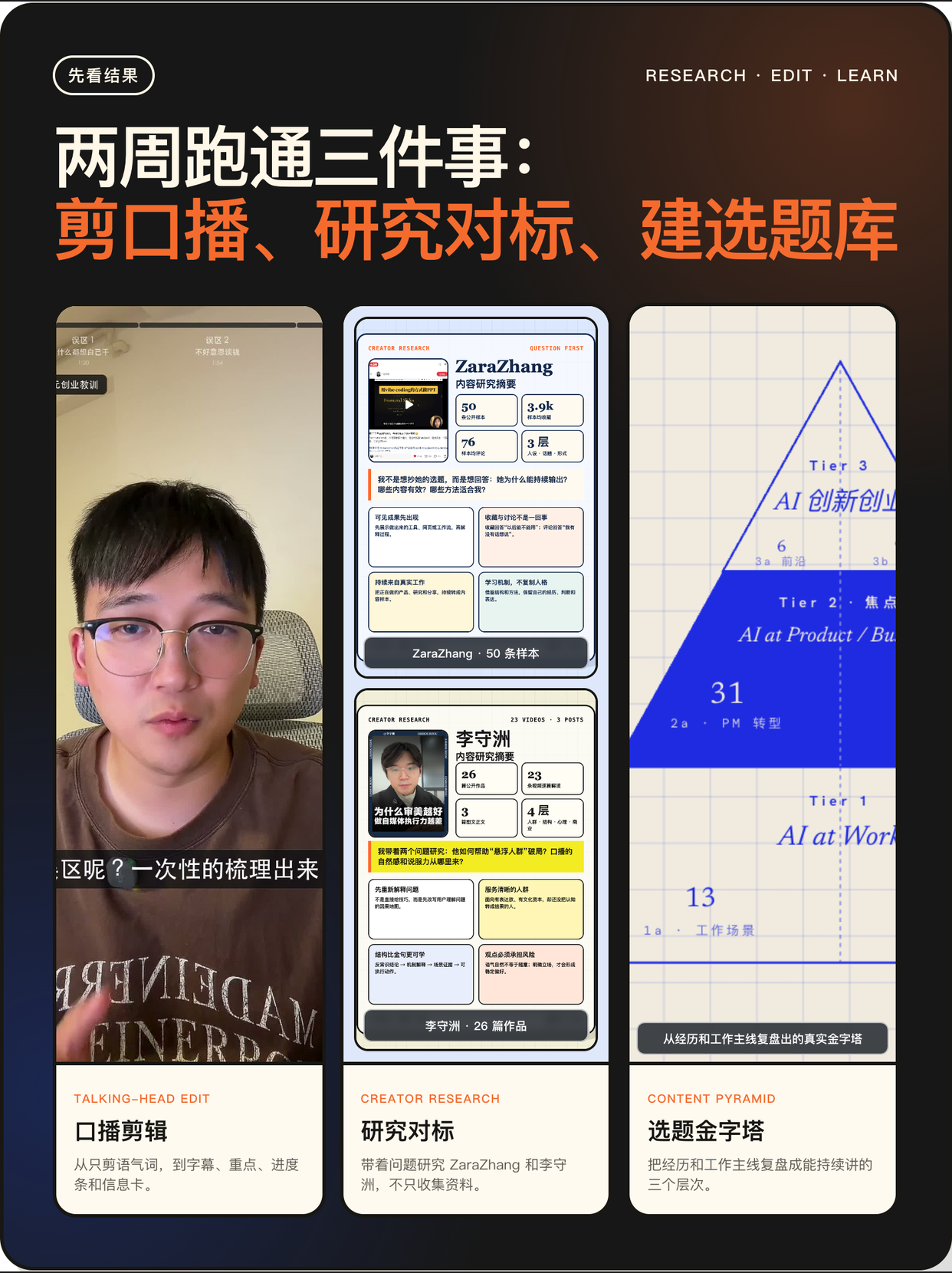
The visual summaries in this article are currently in Chinese. This one shows the three working outputs: edit, research, and topic development.
Here is how I designed the system.
I broke the consistency problem into three factors:
- Topic selection relies too heavily on inspiration. When work gets busy, good ideas disappear. Where do you get a dependable stream of topics?
- Production is expensive. Writing, designing visuals, filming, and editing all take too long.
- Early on, there is very little positive feedback, so it is easy to quit.
01 / When inspiration appears, act immediately
Maybe this happens to you too: ideas come easily while walking or talking with a friend, but the moment you sit down or face a camera, you no longer know what to say. Even when you capture a one-line note, you may forget the context that made the idea worth sharing in the first place.
So how do you generate ideas—and keep them alive? I use three methods.
1. Find the setting where ideas come naturally. Everyone is different. For me, a walk through the small park near my home reliably gets my mind moving.
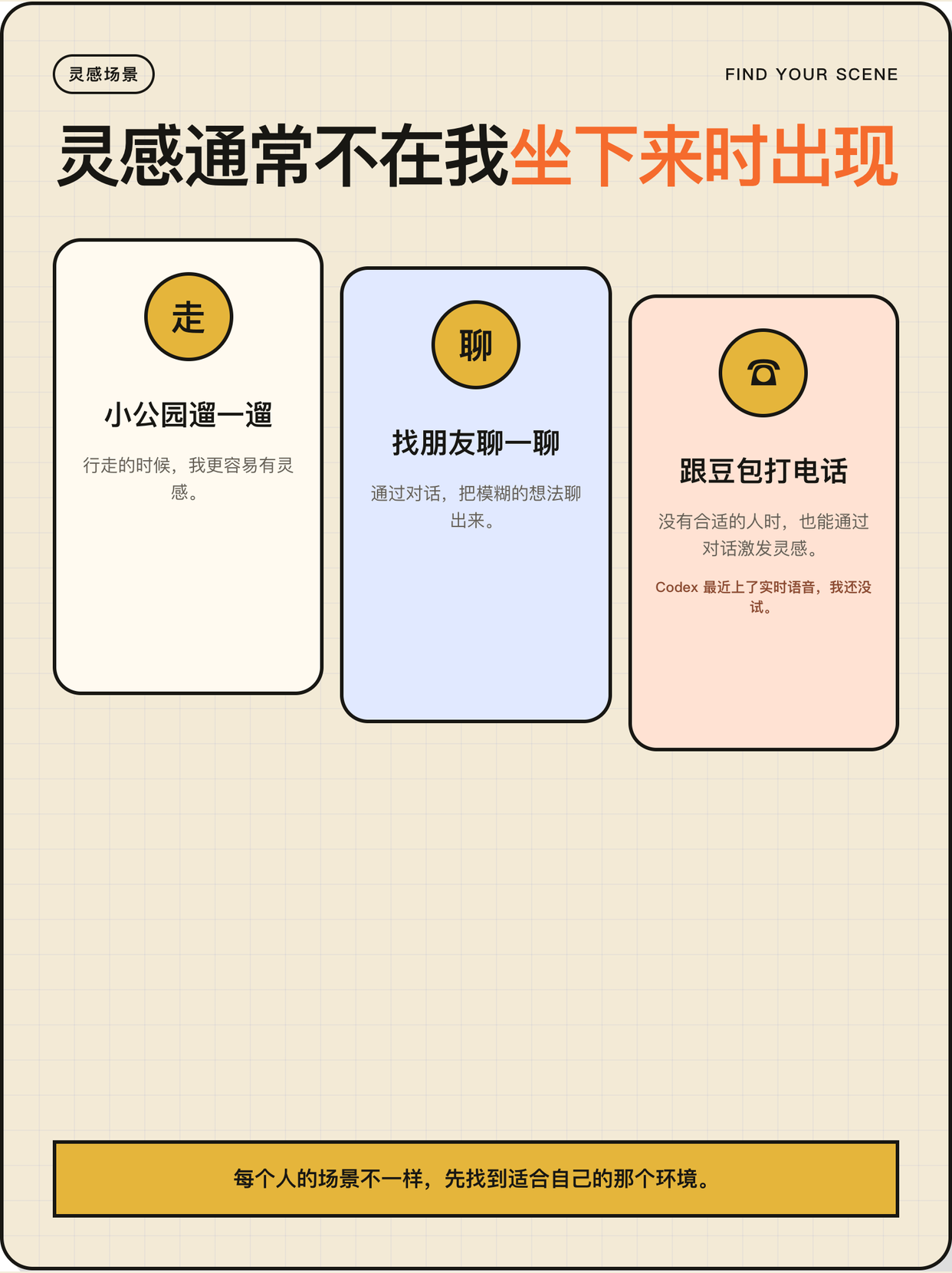
The visual suggests three possible “idea environments”: a walk, a conversation, and a phone call.
2. Use conversation to unlock ideas. You can talk with a friend or call an AI assistant such as Doubao. Dialogue often surfaces ideas that would never appear in front of a blank page. Codex recently added real-time voice, although I have not tried it yet. I will share what happens after I do.
3. Preserve the context before the idea fades. A short note is often not enough. Weeks later, you may remember the topic but not why you felt compelled to talk about it.
My current solution is to message Codex through Feishu as soon as an idea appears. I explain what triggered the thought and what should happen next—for example, whether the topic needs further research.
I use the open-source CC-Connect project to connect Feishu and Codex. It lets me assign work to Codex directly from Feishu, which has been genuinely useful in practice.

Instead of saving a vague one-line note, I record the reason behind the idea and the next action while the context is still fresh.
02 / A topic system that does not depend on inspiration
The first source of topics is an internal review. Give Codex detailed material about your education, career, and entrepreneurial experience—your résumé, for example, or more complete records of the work you have done.
Codex can compare your recent experience with your current professional focus and help identify what you are genuinely equipped to share.
In my case, several years of building AI products give me credible material on topics such as:
- using AI to solve problems at work;
- moving into product management without a technical degree;
- using AI to solve customer-acquisition problems in a startup.
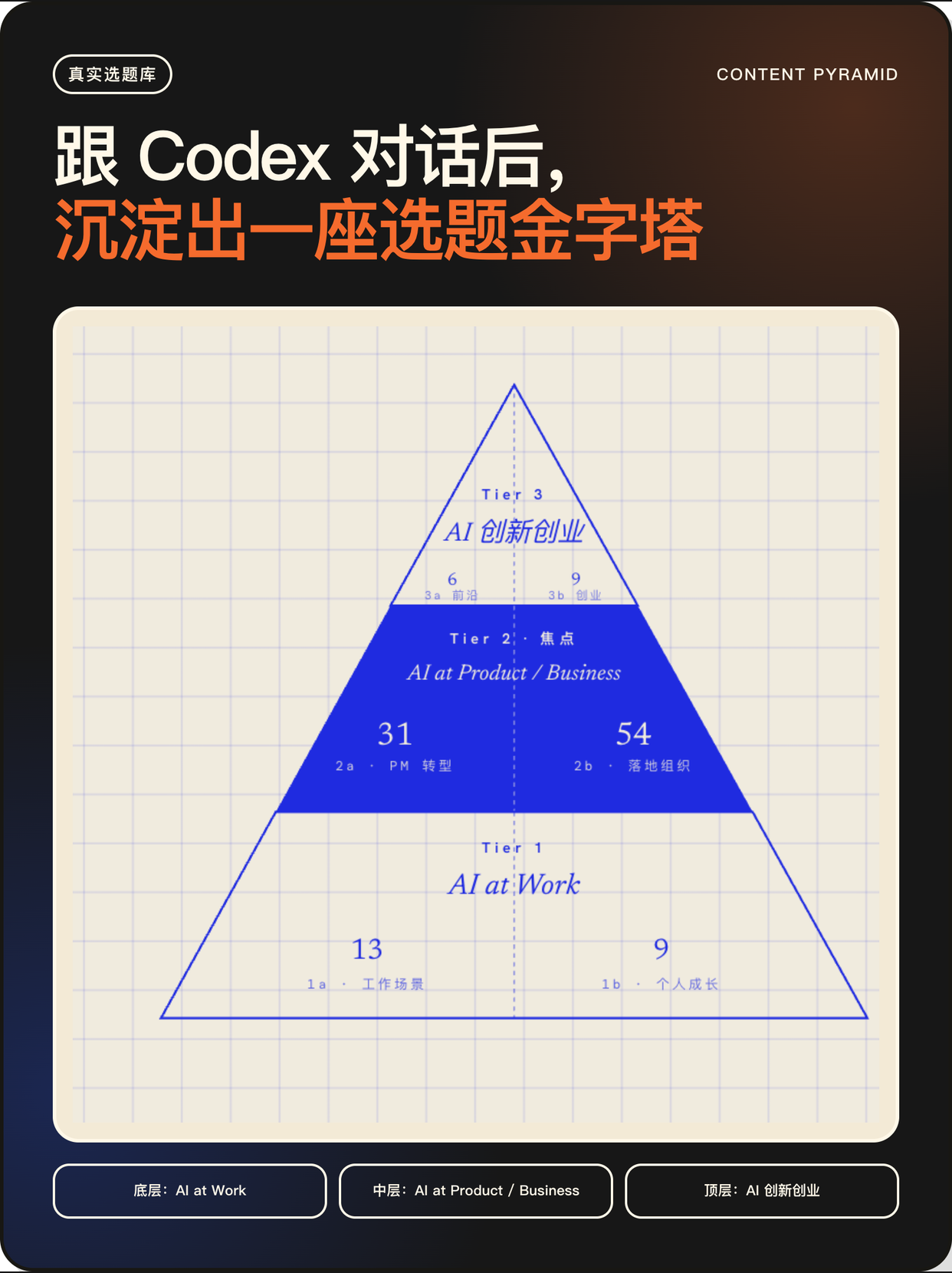
The pyramid organizes possible topics into AI at work, AI in products and business, and AI entrepreneurship.
Each broad theme contains many specific questions. But there is an important filter: being capable of researching a topic does not mean it belongs in your content strategy. I could study how to retouch images with Codex or use it to produce short-form dramas. The problem is that neither is connected to my main body of work.
If I deliberately pursue those topics, the research cost becomes too high.
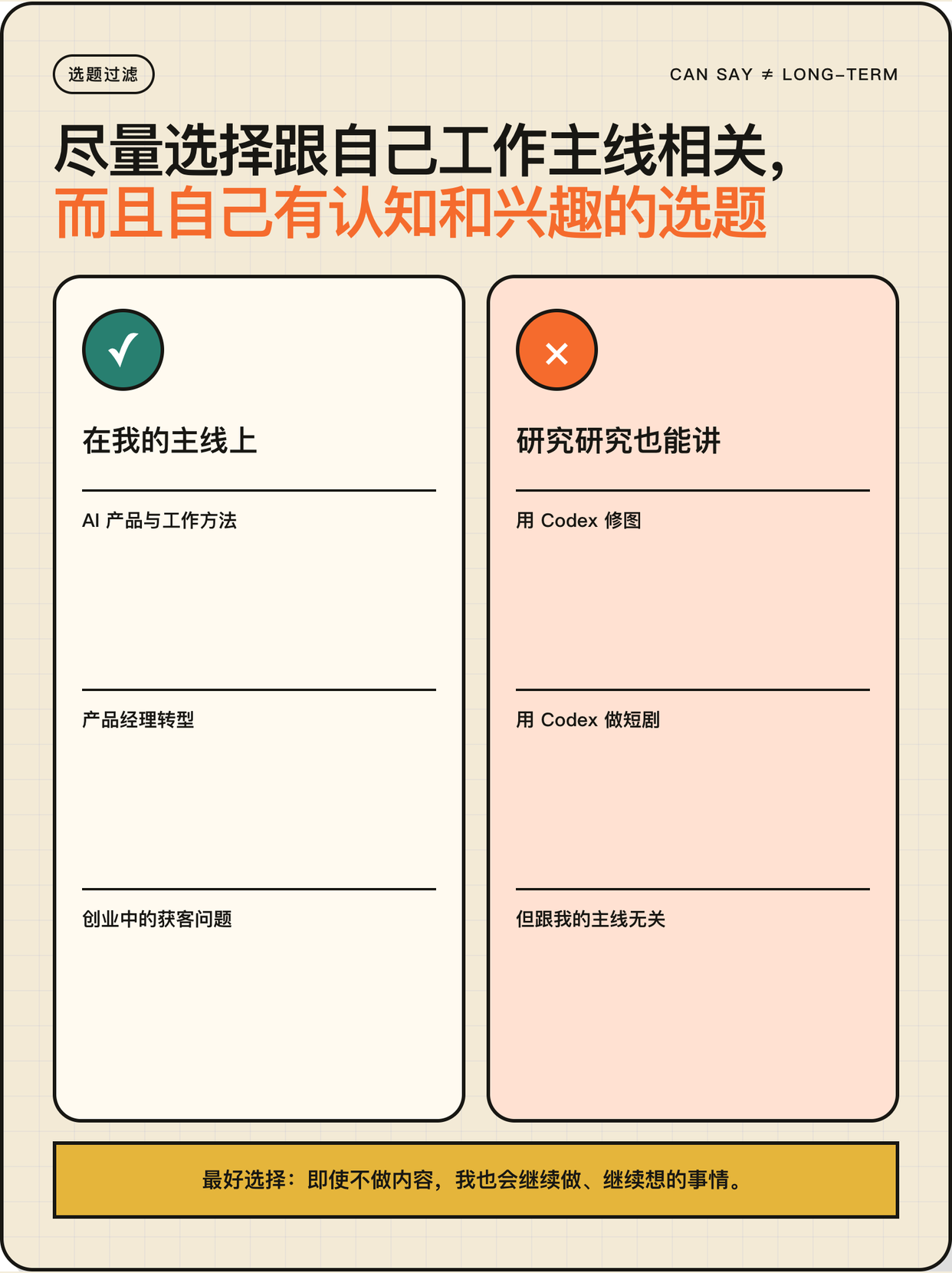
The useful side contains topics tied to your work, product experience, and current business; the other side contains interesting but strategically disconnected research.
The second source of topics is external benchmarking.
Benchmarking does not mean copying other people’s words. If you simply relay what everyone else is saying, you stop building your own media presence and become a distributor for someone else’s.
Some technical shortcuts may help in the short term. Over time, however, trust comes from combining things you have actually lived through, your own point of view, and solutions that are useful to other people. In the AI era, that combination is increasingly scarce.
When I studied ZaraZhang, for example, I wanted to answer two questions: why can she publish consistently, and which of her recurring themes overlap with ideas I have developed through my own experience?
I plan to open-source a Skill called “Research a Creator You Admire.” You will give Codex the creator’s account and the question you want to answer. Codex will then study the creator’s work through that lens rather than collecting a pile of undirected material.

Question-first research turns creator analysis into a focused investigation rather than a scrapbook of examples.
03 / Write the early drafts yourself; let AI support the other stages
If I am already using Codex for content production, why not let it write the script too?
I tried. I described an idea or provided a rough outline, then asked Codex to write. The result often carried too much unmistakable AI phrasing—stock expressions that sounded polished but did not sound like me.
That forced me to reconsider what writing is for. Drafting is not merely a production task. It is an opportunity to review what you think and practice communicating one focused idea clearly within a limited amount of time.
At least while I am still building this habit, I insist on writing text-first scripts myself.
This is not an argument against AI-assisted creation. It is a conclusion from my own detour. If you are new to creating and dictate everything to an AI that then writes the final piece, you may skip too much of the thinking. Instead of obsessing over how to “remove the AI tone,” it may be better to strengthen the underlying craft.
I built a small tool to help me practice. It gives me five minutes to explain one topic with a clear point and structure. If it proves useful, I will open-source it.
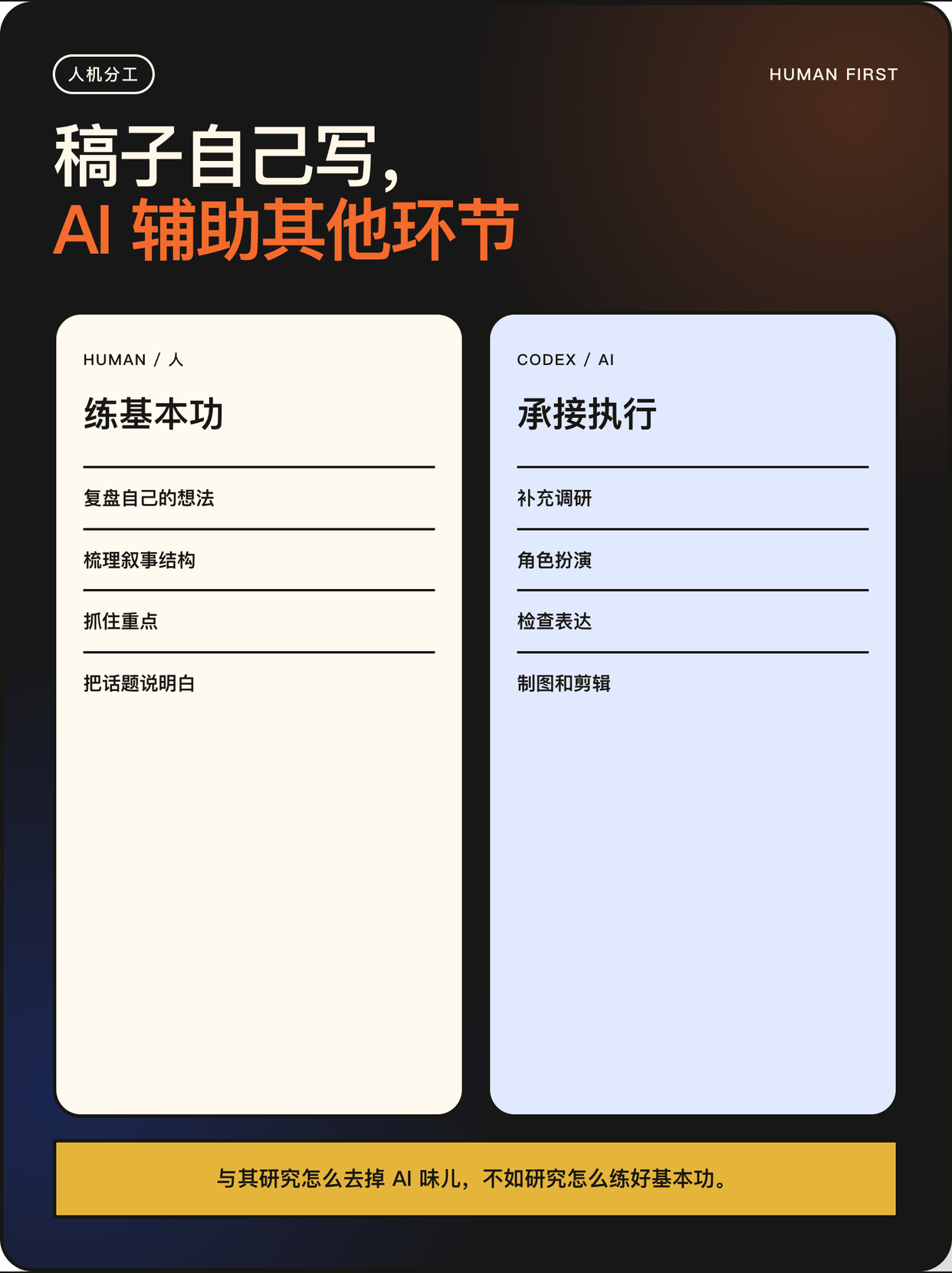
My current division of labor is simple: the human owns the argument and lived experience; Codex supports the surrounding work.
04 / Let Codex take on the editing work
I now use Codex with the open-source video-use project to edit talking-head videos. I have also developed my own talking-head editing Skill, which I plan to share in Xiaohongshu’s Skill section.
But do not assume that downloading any Skill will immediately produce an exceptional result.
My experience is to let Codex edit one video without a Skill first. It may solve parts of the task better than expected and reveal what the eventual workflow should preserve.
Then ask it to create several versions using different approaches. If the results do not match your expectations, give specific feedback.
Codex and I went through three to five alignment rounds before the output became something I liked. The visual below shows three versions made with Codex and video-use.
The earliest version could mainly remove filler words, and it sometimes cut too aggressively, making the delivery feel stiff. Through iteration, I added emphasized phrases, a progress indicator, and eventually information cards.
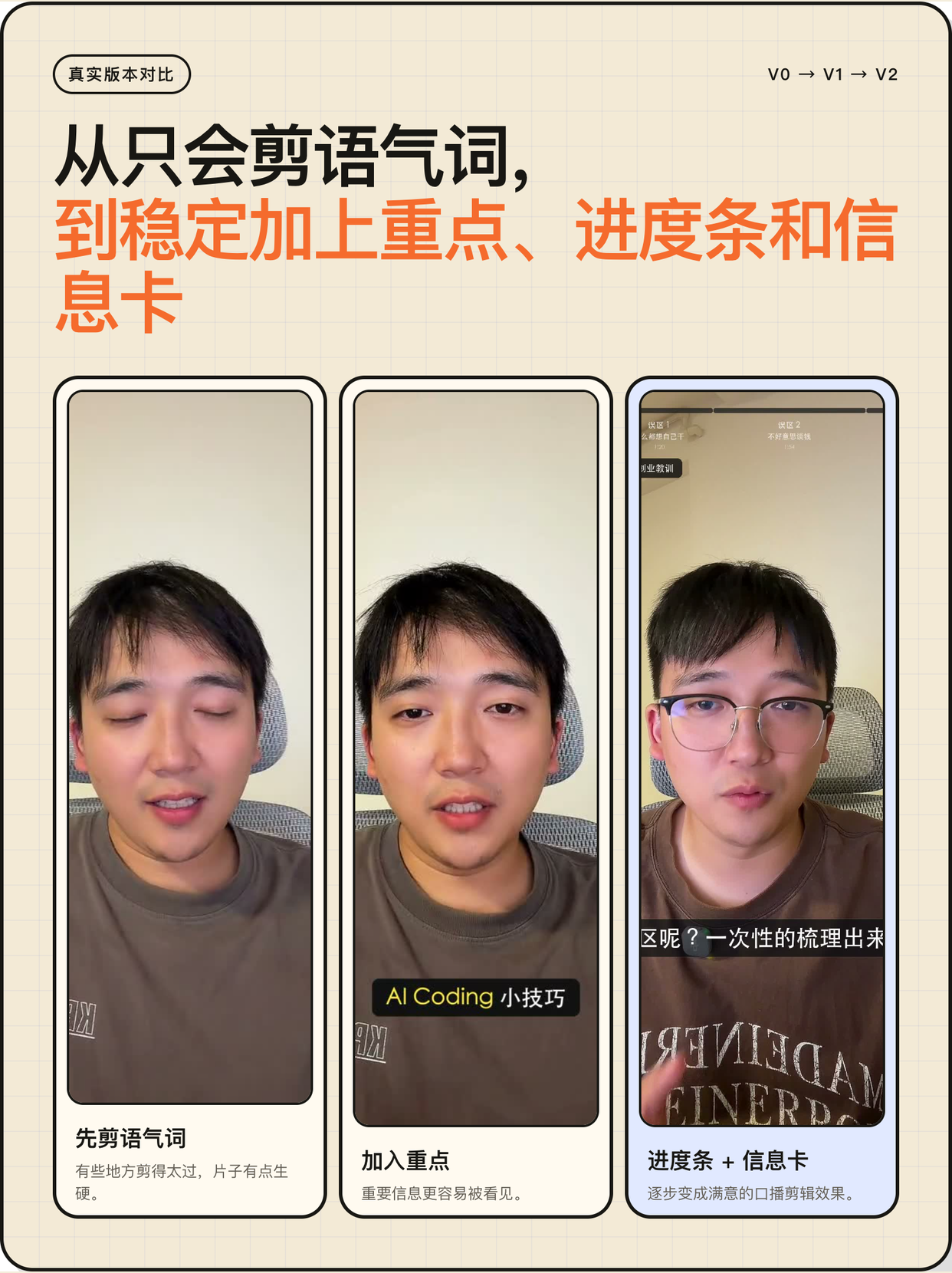
The workflow improved through feedback: remove filler words first, then add emphasis, progress, and contextual information.
05 / Treat your first ten posts as deliberate practice
At this point, the basic system exists: topics can keep coming, production costs are lower, and quality still has a standard.
The final problem is feedback. When you start creating, the work may not be very good and you probably do not have an established audience. My mindset is that the first ten pieces are practice.
What I want from them is a better understanding of content and a working production process. Results can become the priority later.
There are three traps I have already encountered:
- Over-sharing the inner journey. Unless the story is genuinely compelling, readers may not care about every emotional turn.
- Forgetting the audience. What does someone gain by watching or reading—something useful, something entertaining, or ideally both?
- Trying to satisfy everyone. AI-generated writing often smooths away every sharp edge. Before Codex trains us into sameness, we need to discover and protect our own voice.

The first ten posts are for building the craft, not proving that you have already “won” at distribution.
Looking back, the system has six parts, each solving a specific problem: capture ideas before they disappear; build a topic library so you know what to say; benchmark with a question so you can develop judgment; structure the narrative while the human writes the argument and AI plays the audience; hand editing and visual production to Codex to reduce production cost; and finally, turn validated standards, steps, and revision experience into reusable Skills.

The full loop turns one-off effort into a reusable system: capture, topics, research, writing, production, and feedback.
Over the next few days, I will share more focused pieces on editing videos with Codex, creating covers, and researching creators we admire.
If that sounds useful, stay tuned.